storm-research-skill
STORM Research Skill


An Agent Skill for STORM-style deep research: perspective-guided interviews, source-grounded synthesis, structured outlines, inline citations, and verification notes.
This skill packages the Stanford STORM research pattern as a reusable workflow for coding agents that support SKILL.md-based Agent Skills. It is based on the original stanford-oval/storm project.
Why It Stands Out
Use storm when you need a traceable research workflow rather than a shallow
one-shot summary.
| Highlight | What it provides |
|---|---|
| Perspective-guided depth | A basic fact writer, focused viewpoints, simulated interviews, and an evidence-refined outline |
| Auditable evidence chain | Source IDs, query and evidence records, inline citations, reference checks, and visible evidence gaps |
| Guarded and recoverable | Versioned state, one enforced next action, staging, artifact hashes, and retry-safe publication for file-producing runs |
| Interactive exploration | A prompt-native Co-STORM preview with visible simulated participants, a cited mind map, and free-form steering |
| Portable core | A standard Agent Skill layout and bundled runtime scripts with no third-party Python dependency |
| Flexible evidence paths | Experimental Agent-ranked and local lexical retrieval, plus official Classic output import |
Classic STORM is the default. The Co-STORM experience is an Agent workflow, not
a bundled knowledge-storm runner.
See It in Action
One Classic STORM prompt progresses through a topic-only outline, an evidence-refined outline, a cited draft, and a polished article with references and verification notes.
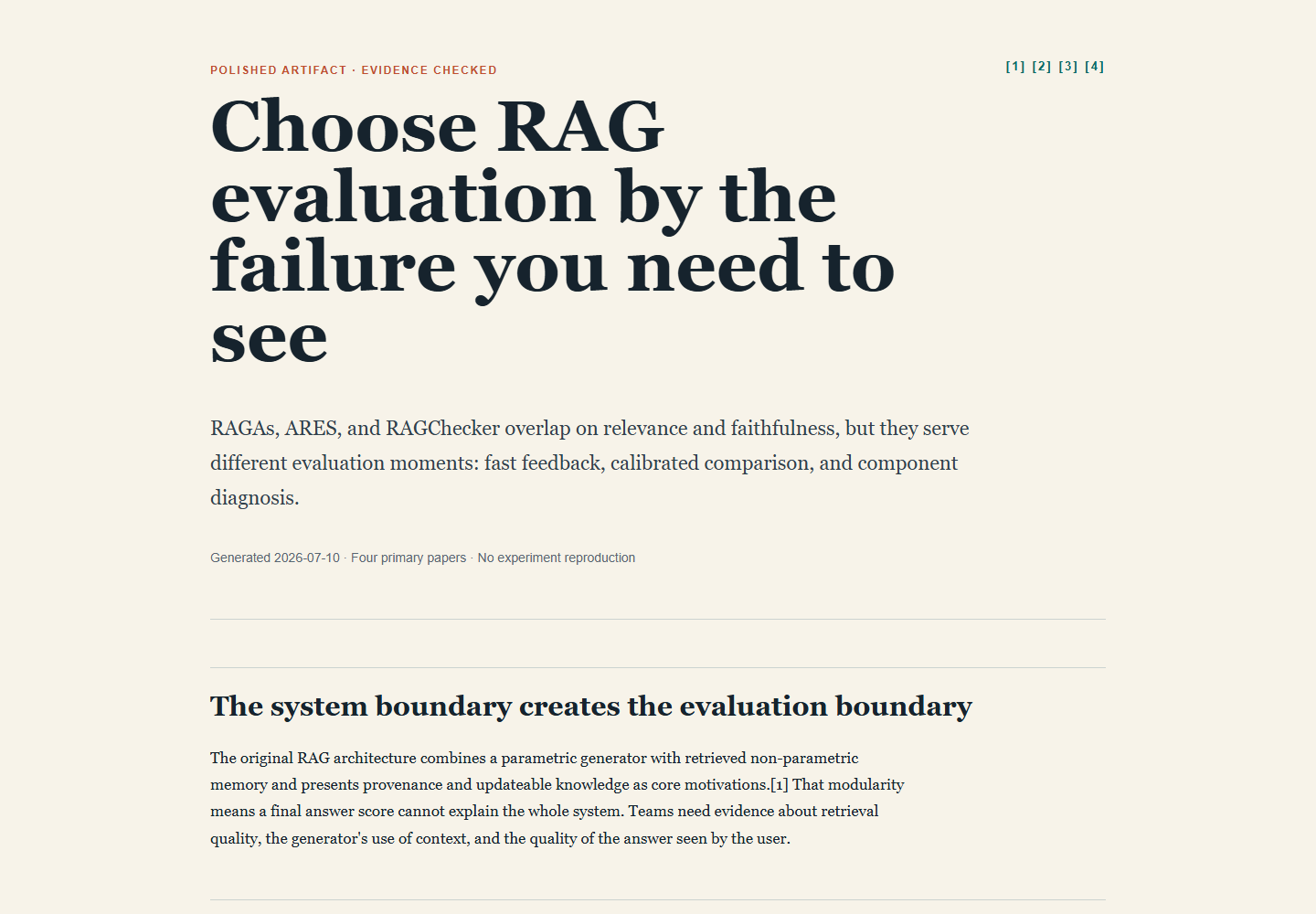
| Mode | What remains visible | Example |
|---|---|---|
| Classic STORM | Four stable research artifacts, source-grounded evidence, and verification notes | Explore the complete RAG evaluation bundle |
| Prompt-native Co-STORM preview | Simulated participant handoffs, cited mind-map updates, open questions, and user steering | Read the compact RAG evaluation roundtable · Open the end-to-end RAG technology report |
These examples are source-grounded output snapshots, not benchmark claims. The Co-STORM example remains a prompt-native preview and does not claim to run the upstream CoStormRunner.
Install
Install with:
npx skills add lizhouai/storm-research-skill
This installs the skill for the current project. Add -g only when you intentionally want a global installation, and use the same scope when updating.
Usage
Use storm through your agent or in Codex. Describe the goal and inputs; it
selects the route.
| Goal | Example prompt | Result |
|---|---|---|
| Classic research | $storm Research the current state of AI code review tools. |
Four validated HTML artifacts under .results/<topic-slug>/ |
| Chat-only brief | Use storm to summarize current RAG evaluation methods. Return the answer in chat and create no files. |
Compact cited synthesis with reduced validation |
| Local corpus | Use storm to synthesize this repository. Do not search outside the provided material. |
Corpus-restricted research within the source boundary |
| Co-STORM roundtable | Use the prompt-native Co-STORM preview to explore embodied AI business models. |
A simulated, cited discussion and evolving mind map |
| Existing runner | Run the STORM project in ./vendor/storm and validate its outputs. Do not install dependencies. |
Authorized local execution mapped into the guarded artifact lifecycle |
| Official Classic output import (Experimental) | Import the completed official Classic STORM run from D:/private/storm-output. |
Guarded phased import of a compatible run |
Co-STORM supports free-form steering; suggestions are optional. Say
Conclude the roundtable for an in-chat report, or add a format and destination
to write the requested mind map and/or report. Ask to persist, resume, or hand
off when durable turn state is required.
Experimental: automatic retrieval routing (Agent-ranked or local lexical) is the default for guarded evidence retrieval. Official Classic output import activates only for an existing run. Both fail closed and may change before becoming stable.
Output Format
Guarded Classic research produces this standard HTML artifact bundle under .results/<topic-slug>/:
direct_gen_outline.html: topic-only outline before evidence refinementstorm_gen_outline.html: evidence-refined outlinestorm_gen_article.html: cited draft articlestorm_gen_article_polished.html: polished final article with references
If you explicitly ask for chat-only or no files, the skill can instead return a compact in-chat brief with perspectives, query log, citations, references, and verification notes.
The guarded Classic artifact validator does not accept non-HTML files. Do not claim guarded completion for another Classic file format.
The Co-STORM preview is conversation-first and never creates the four Classic STORM files. Without an explicit file request, its final report remains in the conversation. For file output, it writes only the requested Co-STORM artifacts:
co_storm_mind_map.<format>: the cited mind map and open questionsco_storm_report.<format>: the final report synthesized from the mind map
Ask for a complete Co-STORM file bundle to receive both. If the request names
neither a format nor a destination, file output defaults to HTML under
.results/<topic-slug>/.
When To Use It
Good fit:
- research reports
- background reviews
- literature reviews
- competitive or market scans
- technical landscape summaries
- source-grounded policy or historical synthesis
- multi-perspective explanations of contested topics
Less useful for:
- quick factual lookups
- tasks where no citations are needed
- implementation work that mainly needs code changes
- unsupported speculation or opinion writing
Workflow
Classic STORM follows this sequence:
- Frame the topic and deliverable.
- Generate writer perspectives.
- Run simulated interviews for each perspective.
- Build an information table from gathered evidence.
- Draft and refine the outline.
- Write the standard artifact bundle.
- Polish, reorder citations, verify claims, and check artifact encoding.
File-producing Classic and Local Runner requests default to the bundled guarded
runtime when Python is available. A versioned .storm-run/run.json and event
log define the only next action; zero-dependency scripts enforce state
transitions, artifact structure, hashes, and citation mappings before the run
can reach COMPLETE. Phase outputs remain under .storm-run/staging, so the
four public files stay absent before validation. The final transition publishes
each validated file through atomic replacement and records the bundle hashes in
.storm-run/publication.json;
completed runs revalidate that receipt. Prompt-only fallback remains available when Python is
unavailable or the user explicitly requests chat-only output, with the reduced
enforcement boundary stated in the response.
Experimental retrieval is bundled without a model dependency. Host mode records rankings supplied by the current Agent or runner, lexical mode provides deterministic zero-dependency BM25 with Unicode/CJK terms, and neither mode loads provider code or performs network access. The requested/effective backend and ranking metadata remain in the internal retrieval trace.
An experimental zero-dependency adapter can probe an existing knowledge-storm
installation without importing it and map stable >=1.1.1,<1.2 Classic runner outputs
into the same guarded lifecycle. It reads one next_action at a time, redacts
runner configuration, hashes rather than copies LM history, escapes upstream
text into staging HTML, and leaves state advancement, citation decisions, and
publication to the existing guarded CLIs. The adapter does not bundle or
install knowledge-storm/DSPy and requires the polished article’s separately
captured reference map instead of assuming draft citation ids still match.
The prompt-native Co-STORM preview is used only when you explicitly ask for interactive exploration, roundtable discussion, user steering, or a mind map. It starts with a mini STORM warm start, renders role-attributed simulated discussion instead of hiding participants in internal state, maintains a cited mind map during the conversation, and returns the final report in chat or writes only requested artifacts when you ask to conclude. The Co-STORM reference describes the portable prompt protocol, but this repository does not bundle DSPy modules, independently running expert agents, or an executable Co-STORM runner.
For persistent Co-STORM runs, record-turn validates turn order, stable
participant identities, retrieval/source mappings, citations, mind-map delta
shape, final-report intent, and a hash-linked turn log before outer lifecycle
transitions. The bundled Classic artifact validator does not mechanically
verify Co-STORM mind-map or report contents; the agent must still review their
source and citation support before claiming completion.
Co-STORM Interaction Flow
flowchart TD
    A["Explicit interactive Co-STORM request"] --> B["Initialize the conversation-local board"]
    B --> C["Warm start once<br/>Basic fact writer and up to two specialists"]
    C --> D["Build the cited mind map and open questions"]
    D --> E["Render the visible roundtable<br/>Active experts and Moderator"]
    E --> F{"User's next action"}

    F -->|"Continue or redirect"| G["Update the current focus and evidence"]
    G --> H["Named primary speaker and a different respondent"]
    H --> I["Moderator intervenes when due"]
    I --> J["Update discourse, citations, mind-map delta, and open questions"]
    J --> E

    F -->|"Save, resume, or hand off"| K["Export the visible board<br/>Persisted runs retain the validated turn log"]
    K --> E

    F -->|"Conclude"| L["Record the final turn when persistent<br/>Synthesize branches and disagreements"]
    L --> M["Return the final report<br/>Write files only when requested"]

    N["Interactive rounds have no fixed limit"] -.-> E
The warm start happens once. After that, the roundtable remains in the interactive loop until the user asks to conclude; continuing, redirecting, or checkpointing does not consume a predefined number of rounds.
Repository Structure
storm-research-skill/
  README.md
  CHANGELOG.md
  LICENSE
  CONTRIBUTING.md
  assets/
    social-preview.png
  evals/
    baseline-results.json
    cases.json
  examples/
    README.md
    classic-rag-evaluation/
    co-storm-rag-evaluation/
    co-storm-rag-technology/
  release-notes/
    v0.5.0.md
  scripts/
    run_forward_evals.py
    validate_skill.py
  tests/
  skills/
    storm/
      SKILL.md
      agents/
        openai.yaml
      references/
        artifact-contract.md
        classic-storm.md
        co-storm.md
        co-storm-turn.schema.json
        local-runner.md
        knowledge-storm-adapter.md
        retrieval-backends.md
        run-state.schema.json
        safety-contract.md
        storm-method.md
      scripts/
        audit_citations.py
        retrieval_backend.py
        runner_adapter.py
        storm_state.py
        validate_artifacts.py
skills/storm/SKILL.mdis the skill entry point and activation contract.skills/storm/references/contains mode-specific workflows and contracts;storm-method.mdremains a compatibility index.skills/storm/agents/openai.yamlprovides display metadata for OpenAI-style agent surfaces.assets/social-preview.pngis the upload-ready repository social preview; theFact Researcherlabel is visual shorthand for the canonical Basic fact writer role.examples/contains a complete Classic artifact bundle, a compact prompt-native Co-STORM interaction, and an end-to-end Co-STORM report run.evals/baseline-results.jsonpreserves the historical pre-runtime behavior snapshot; it is not the current executable-canary result.evals/cases.jsondefines executable forward-eval cases and objective oracle assertions for critical modes and safety boundaries.scripts/run_forward_evals.pyruns isolated offline contract canaries and can invoke an explicitly configured real-Agent command without making that nondeterministic path a release gate.scripts/validate_skill.pyenforces the repository contract without third-party Python dependencies.- The repository root intentionally does not contain
SKILL.md; the standardskills/storm/layout lets the skills CLI install the whole bundle.
Compatibility
This repository uses the Agent Skills SKILL.md format. Local discovery and bundle installation are validated with the npx skills CLI. Other compatible agents can read the same skill, but tool availability, native choice UI, and automatic triggering vary by host.
Different agents expose skills differently. If explicit invocation syntax is unavailable, ask the agent in natural language to “use the storm skill”.
Updating
Update a project-local installation with:
npx skills update storm
For a global installation, use the matching global scope:
npx skills update storm -g
See CHANGELOG.md for release history and upgrade-relevant changes.
Contributing
See CONTRIBUTING.md for local setup, validation, changelog, and release instructions.
License
MIT License. See LICENSE.
The original stanford-oval/storm project is also released under the MIT License. See the original STORM paper and Co-STORM paper for the research systems this prompt-native skill adapts.